For teachers
AI as a thinking partner for students
Most students use AI one way. They type the question, take the answer and move on. I call that the vending machine, and it's the only way most of them know, because nobody has shown them another. The other way is to use AI as a thinking partner, and it has to be taught.
What a thinking partner does
A thinking partner pushes the student's own thinking. The student still makes the decisions: what to check, what to keep, what to throw out and what to argue. AI gives them something to push against.
How AI is set up makes a real difference. In a field experiment with nearly a thousand high school maths students, those with open access to GPT-4 scored 17% lower once the tool was taken away than students who never had it. Students given a version that guided them through problems, without handing over answers, largely avoided that drop (Bastani et al., 2025). At Harvard, physics students learning from an AI tutor built to walk them through each step learned more in less time than in an active learning class (Kestin et al., 2025). Neither study is about school classrooms like yours, but both point the same way. The tool matters less than whether the thinking stays with the student.
Three zones of thinking-partner use
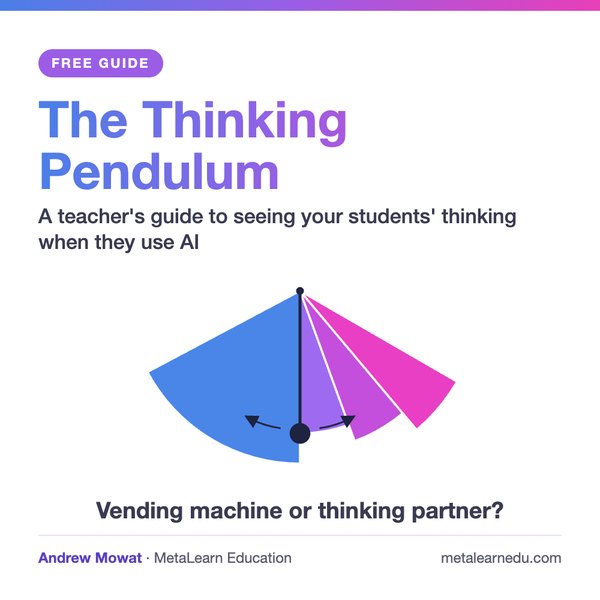
In the Thinking Pendulum, the thinking partner is Mode 2. It has three zones, and each one asks students to do something different.
Sense checking: is this answer right? A student asks AI for a summary, then finds what's missing and what's wrong. This is the easiest zone to teach and to see, so start here.
Outcome determining: the problem is known, the solution isn't. AI becomes a sparring partner. Students come up with three possible arguments or approaches before choosing one, and they have to say why.
Problem shaping: the problem itself is still unclear. Before any AI comes in, students reframe the question in their own words. What is it really asking? Where's the tension in it?
The easiest first move: press, then check
You don't need to redesign anything to start. Let students press the button, then ask them to check what came back.
| Press (Mode 1) | Then check |
|---|---|
| Ask AI for a summary | What's missing, and what's wrong? |
| Ask AI for an answer | Check it against one other source |
| Ask AI for a paragraph | Keep or reject each sentence, and say why |
| Ask AI to solve a problem | Explain the solution without looking |
Small, regular pushes like these build the habit.
Getting students to push back
Once checking is routine, ask students to argue with AI. Two routines work well:
- Counterclaim ticket. Ask AI for the strongest argument against your claim. Put it in your own words, then keep it or reject it, with a reason.
- Check before you trust. Any claim that came from AI has to be confirmed in two sources the student has actually read.
Use one or two per task. Both replace work students already do, so they cost little or no extra class time.
What it looks like in one task
Year 10 English: "How does the writer present power in the novel?"
| Stage | AI permission | Thinking zone | Evidence it leaves |
|---|---|---|---|
| Understand the question | No AI | Problem shaping | Question reframe |
| Research | AI allowed | Sense checking | Keep / reject log |
| Plan the argument | AI as sparring partner | Outcome determining | Three options, one chosen |
| Draft | No AI | Own thinking | The draft itself |
| Final check | AI allowed | Mode 1, then sense checking | Declaration and one correction |
Most AI policies set one level for a whole task. This goes a layer deeper: which stages allow AI, what thinking each stage asks for, and what evidence it leaves behind. If your school already uses an AI assessment scale, keep it. The scale sets permission and the pendulum describes the thinking, so the two sit side by side.
Questions teachers ask
Isn't the vending machine sometimes fine?
Yes. Mode 1 is fine when the thinking has already been done. Ask students to declare when they've used it, and why it was the right call.
What age can students start this?
In primary, start at sense checking with the teacher driving the AI, and add one zone per phase. By senior school, students are choosing the swing themselves. Sense checking doesn't even need AI: a textbook paragraph or a classmate's answer works just as well.
Does this work outside English?
Yes. The examples here come from English, but the starting question works in any subject: what's unknown to the student? The free guide includes a planning prompt that builds the stages around your own task.