Your students are using AI like a vending machine, and it can feel like there's not much you can do about it.
There's more you can do than you think, and it starts with how the task is designed. The Thinking Pendulum shows you how to redesign essays, lab reports and extended essays so the thinking has to be your students' own, and how to plan and assess so you can see it when it is.
A free guide and rubric you can use in a unit you're already planning.
The pendulum swings with the task
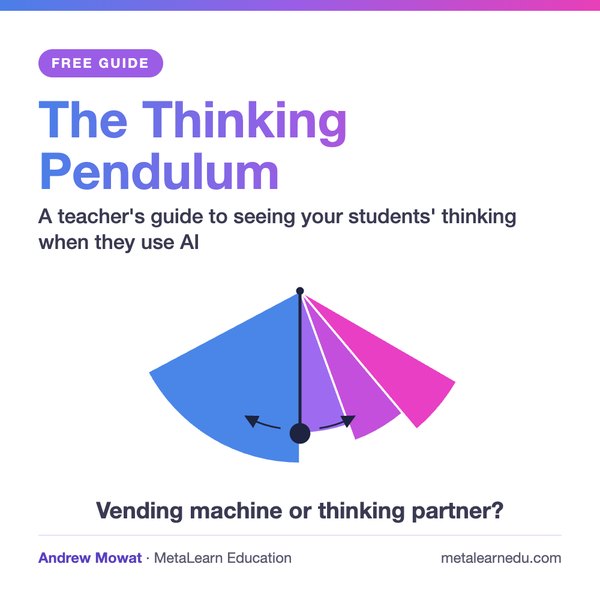
The Thinking Pendulum is Andrew Mowat's model of the two ways students use AI: as a vending machine that hands over answers, or as a thinking partner that pushes their own thinking.
Sometimes a quick answer is exactly right. The trouble starts when that's the only way students use AI. The Pendulum shows the second mode, the thinking partner, and its three zones, and gives schools a way to build them one step at a time.
Choosing the right mode for the moment is the skill we're really teaching.
What each zone looks like in a real classroom
Each zone draws on a different kind of thinking. Here is the signature cognition behind each one, and one sign that a student is using it while working with AI.
Mode 1Vending machine
Delegation
2.1Sense checking
Verifying
2.2Outcome determining
Weighing
Deciding
2.3Problem shaping
Framing
Questioning
The full version, with every form each zone takes, the signals to look for in class without AI, and the emotional signals that tell you the work is at the right level, is part of the Pendulum in Practice editions. See the editions →
Two ways in
For teachers
Classroom-ready tools for teaching students to think well with AI.
- Free Thinking Pendulum guide and rubric
- The Pendulum in Practice editions: Senior, Lower Secondary, Upper Primary (coming soon)
- Online course, coming soon on EduSpark
For schools
Whole-school and group work on AI and thinking, led by Andrew.
- School licence for the Pendulum resources
- Keynotes and staff workshops
- Work across school groups
- Middle leadership development and coaching
The free guide shows you the model. The Pendulum in Practice editions show you how to build it into your tasks.
There's one edition for each phase of school, built on the same five steps. Each step takes a task you already set and redesigns it so the thinking has to happen, and so you can see it when it does.
What you'll be able to do
- Plan each stage of a task for the kind of thinking it needs, and decide where AI helps and where it stays out.
- Read a student's AI log as a trace of their thinking, and see in about a minute whether they checked, weighed options or handed the work over.
- Give marks for the quality of a student's thinking with AI, with rubric wording you can drop into your mark scheme.
- Move a class from checking AI's answers towards shaping problems themselves, year on year.
Some systems are responding by banning AI or dropping take-home work altogether. For younger children, holding AI back makes sense. But senior students meet AI everywhere, and their coursework still has to be set and assessed. Pulling the task removes the problem for a term. Redesigning the task is what grows the thinking.
Worked before-and-after redesigns show it in real subjects, with exam-board notes for coursework and the research behind every step. When a piece of work doesn't add up, there's a fair process for that conversation too. You'll need it less often, because the thinking is already in view.
Senior
Lower Secondary
Upper Primary
Beyond the templates. Every step comes with a prompt you can adapt to your own subject and task. Use it a few times and you'll be writing your own. The edition gets you started, and the skill stays with you.
Questions teachers ask
What is the Thinking Pendulum?
It's a model, developed by Andrew Mowat, of how students think when they use AI. In Mode 1, the vending machine, they press the button and take the result. In Mode 2, the thinking partner, AI pushes their own thinking through three zones: sense checking, outcome determining and problem shaping.
Is the vending machine always bad?
No. Mode 1 is fine when the thinking has already been done. The trouble starts when it's the only way students use AI. Modes are moments, not people: no student is a "Mode 1 student".
Isn't the thinking trace just reflection after the fact?
Less than it looks. The AI chat is written in the moment, so it's close to a live record of the thinking. The step that happens afterwards is labelling each turn with a zone, and that's where the interpretation comes in.
Does this work with younger students?
Yes. In primary, start at sense checking with the teacher driving the AI, and add one zone per phase. By senior school, students are choosing the swing themselves. Sense checking doesn't even need AI.
How is this different from an AI assessment scale?
A scale sets how much AI is allowed. The Pendulum describes the thinking that happens. If your school already uses a scale, keep it. The two sit side by side.

Andrew Mowat, MetaLearn Education
Andrew has spent 42 years in education, in roles from the classroom to school leadership, and is a qualified executive coach. He works with international schools across Asia on how students learn and think, and is co-founder of EduSpark. He is co-author of The Success Zone, a book on the brain, leadership and coaching. He created the Thinking Pendulum to give teachers a practical way to see what's happening in students' heads when they use AI, and to design for the thinking that matters.
Get the free Thinking Pendulum guide
A practical guide and rubric you can use with students this term.
Send me the guideFurther reading: Cognitive offloading and AI: what teachers can do
Further reading: AI as a thinking partner for students
Further reading: A rubric for student thinking with AI
Further reading: How to stop students using AI to do their thinking
For school leaders: AI and academic integrity: what international schools can do
For school leaders: Whole-staff AI professional development: what to do after the prompting workshop
For school leaders: How to communicate with parents about AI