For teachers
How to stop students using AI to do their thinking
Most teachers I talk to have seen it happen. A student hands in work that reads well, and when you ask them about it, there's nothing behind it. AI did the thinking the task was meant to build. Students have the tool at home, so taking it away in class only covers the lessons you can supervise. What you can change is the task. When it's designed well, the thinking has to come from the student, and you can see it.
Step 1: Run the one-go test
Paste your task into a chatbot, exactly as students will see it. If it gives back an answer you'd accept from a student, the task needs work. It takes a couple of minutes. Plenty of good tasks fail it, because they ask for a finished product and nothing about how it was made.
Step 2: Get the thinking started before AI
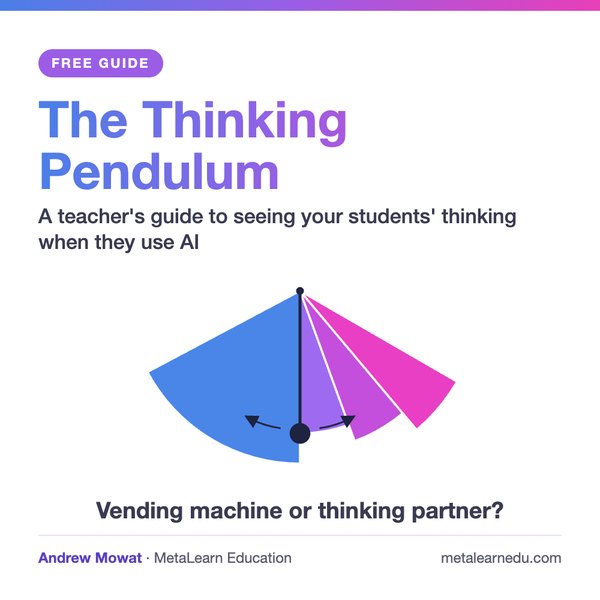
Ask students to put something of their own down before they open a chatbot. That can be a prediction, a first attempt, or the question rewritten in their own words. Then, when AI gives an answer, they have something to check it against. In the Thinking Pendulum this is sense checking, the first zone of using AI as a thinking partner, and it's the easiest place to start because it works with any task.
Step 3: Ask for evidence along the way
Build a few small things into the task. Students note keep or reject against each AI response, with a reason. At each stage they add one line saying what AI did. At the end you ask each student about one decision in their work: why they kept this point, or dropped that one. Those few minutes of conversation tell you whose thinking it was. The rubric for student thinking shows how to mark it.
One task, before and after
Here's a Year 9 History source question.
Before: Source A is a British recruitment poster from 1914. How useful is it to a historian studying why men volunteered to fight? Use the source and your own knowledge.
A chatbot answers this well in one go, so it fails the test.
After: the same question, set in three stages.
- No AI. Students note what the poster wants the viewer to feel, and one reason men volunteered that the poster leaves out.
- AI allowed. Students ask a chatbot how useful the source is. They mark each point keep or reject, with a reason, and check one claim against their textbook.
- Their own answer. Students write the answer and add one line saying what AI did.
Then you ask each student about one point they rejected.
The question and the source haven't changed, and students still use AI. Now they can't get through it without thinking, and you can see where they did.
Skip the detectors
AI detectors aren't reliable enough to accuse a student (the academic integrity page has the evidence), and tricks to make tasks AI-proof stop working as the tools improve.
Questions teachers ask
Does this work with younger students?
Yes. Step 2 is the place to start: a prediction or a first attempt before anything else. Younger students can do the keep or reject step out loud with you, instead of in writing.
What about subjects without essays?
The same steps work in Maths, Science and languages. In Maths, the first attempt might be an estimate or a method, and the keep or reject note goes against each step AI suggests.
How much extra time does it take?
Not much. You're rewriting a brief you'd write anyway, and the conversations can be short, one question each, while students are working.